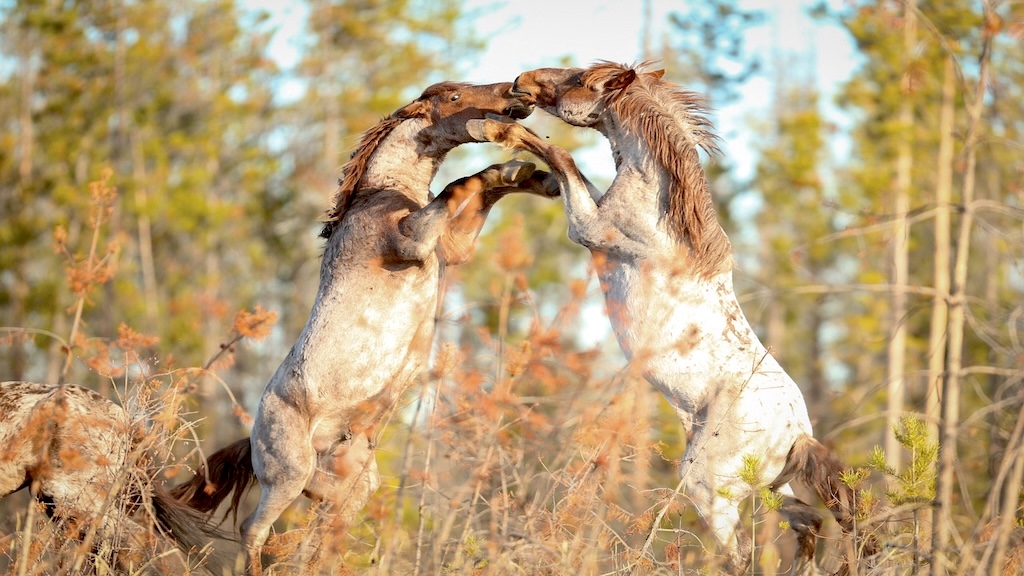
In June 2001, wildlife biologist Wayne McCrory had a dream. He had been contracted by Friends of the Nemaiah Valley to map grizzly bear habitat and document wildlife signs, in order to help the Xeni Gwet’in First Nation, one of the Tsilhqot’in Nations, oppose the planned logging of their ancestral lands – lands to which they had won rights and title through cases heard by the Supreme Courts of British Columbia and Canada.
Once on the ground, McCrory came face to face with the much-maligned wild horses (qiyus) of the Xeni Gwet’in. As a young biologist working in the Galapagos Islands many years earlier, he had seen the damage invasive species caused to healthy ecosystems; he expected the horses to have done the same here. To his surprise, he found a healthy population of fine horses that appeared to have fully integrated into the natural predator-prey ecosystem.

Wild horses in winter | photo from Wild Horses of the Chilcotin, provided by Wayne McCrory
On an early exploration of the area he was investigating, he was charged by a band of wild horses. Later that evening, he dreamed he went on a journey to sacred Ts’il?os (Mount Tatlow). In the dream, McCrory was confronted by a stone horse that came to life. Thus began a twenty-year journey of observation, research, and advocacy, culminating in The Wild Horses of the Chilcotin.