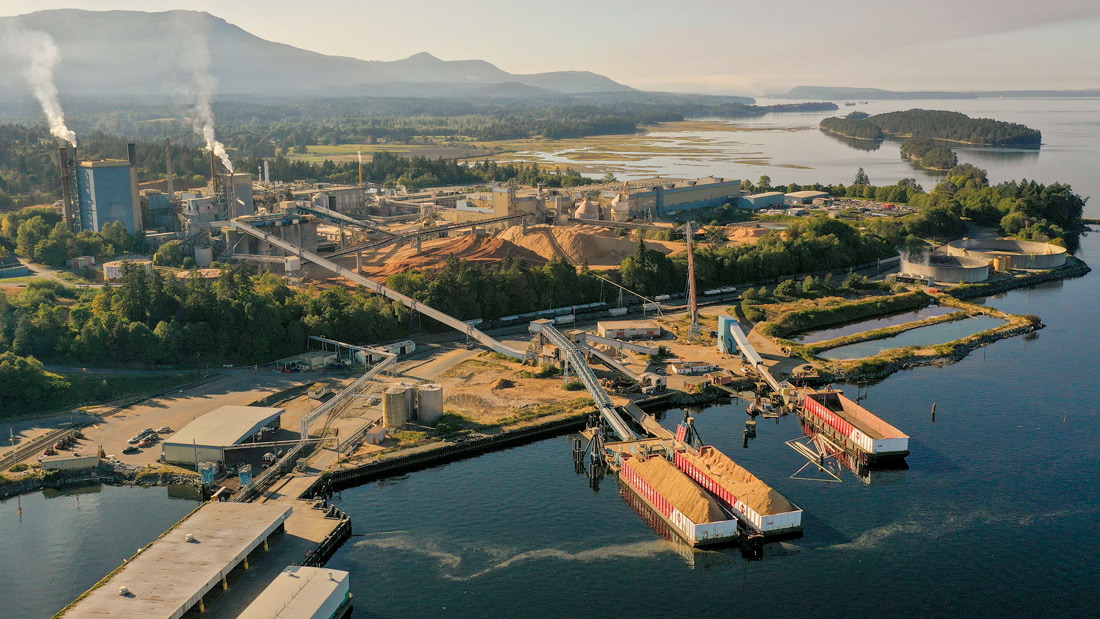
After decades of protests, environmental violations, government fines, and civil claims, it’s the end of an era.
Crofton’s embattled pulp mill is shutting down after 68 years, leaving 350 workers without jobs and destabilizing dozens of businesses in the region.
“The Crofton mill has been challenged for some time now,” Domtar’s paper and packaging president Steve Henry admitted in December 2025. “Unfortunately, continued poor pricing for pulp and lack of access to affordable fibre in BC necessitates the closure.”
The Crofton mill was once part of a recycling system of sorts; it was designed to turn waste from sawmills into energy, pulp, and paper. But a wave of sawmill closures has decimated BC’s pulp and paper industry. In 2003 the Province scrapped its appurtenancy rules that required timber to be milled where it’s harvested. and logging tenures (tree farm licenses) are no longer mandated to maintain or supply sawmills. The Crofton mill was so starved for feedstock it was reportedly importing wood chips from the US.
But as one chapter ends, another one begins. With the loss of the mill comes the possibility that the estuary may eventually heal from decades of abuse.
In the beginning
We can only imagine what the Chemainus River estuary was like in our grandparents’ time. The river delta on Vancouver Island’s east coast was an incredibly rich place. Where it reaches the ocean, the blue-green river slows and meanders across wide shoals into a small bay, protected by a string of small islands just offshore. The Halalt First Nation village of Xulelthw was surrounded by shallows teeming with crabs, oysters, clams, mussels, ducks, and eelgrass. These in turn supported salmon, bears, herons, eagles, and people across the region.
In 1957, BC Forest Products built its pulp and paper mill on the edge of the estuary. Village sites and ancestral burial grounds were paved over with no regard for the people who once lived there.