In December 2025, Domtar announced it would permanently close its pulp mill in Crofton, on Vancouver Island, ending nearly seven decades of operation and eliminating about 350 jobs.
The company’s stated reasons were blunt: weak global pulp pricing and a lack of access to affordable fibre in BC. The mill had already received provincial and federal support in recent years – including an $18.8 million funding package in 2023 to modernize its production – but those efforts were unable to sustain operations.
For North Cowichan, the closure isn’t an abstract “sector adjustment.” Domtar has been the municipality’s single largest taxpayer, contributing about $5 million a year in property taxes, that fund services whether a mill is operating or not. Beyond the payroll, the shutdown lands on the people who make a living around the mill: logging contractors, truckers and mechanics, tug and barge operators, chip suppliers, and the smaller businesses that live off the rhythm of coastal forestry.
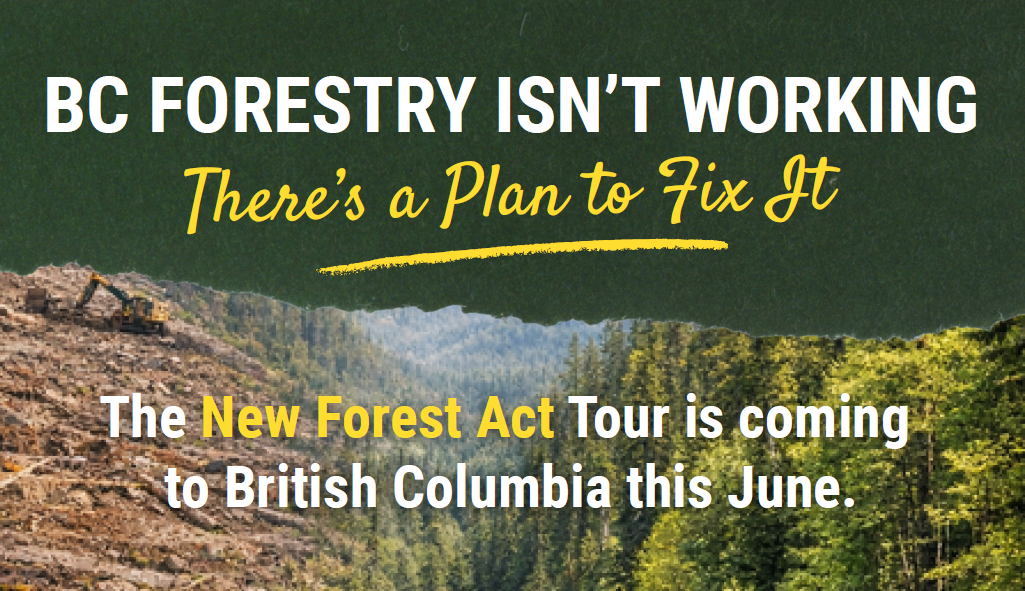
Crofton is part of a broader pattern: shrinking harvest, mill closures, and a wood supply that no longer matches planning projections. The closure illustrates the downstream consequences of a deeper planning issue.
The over-reporting problem
BC’s forest economy is still governed by a number most residents never see: the Annual Allowable Cut, a government-set logging quota, determined region by region, that is meant to reflect what the land base can sustain.
In practice, the AAC is only as reliable as the modelling it’s based on. Timber supply reviews use the Vegetation Resource Inventory, growth-and-yield models, and future harvest projections to estimate how much merchantable timber exists and how quickly it will regenerate. If those inputs are inflated or overly optimistic, the resulting AAC is inflated as well.
A recent independent evaluation of the Mackenzie Timber Supply Area provides a striking example. The report found that wildfire impacts were underestimated in the base case used to determine the AAC. Since 2020, only 2,220 hectares of wildfire were predicted in the model, while more than 55,000 hectares actually burned, with an additional 92,000 hectares potentially rendered inaccessible. The authors state this modelling approach is not unique to Mackenzie and is “most likely being applied across the majority of the province’s regions.”
One indicator is the widening gap between projected supply and actual harvest. The Province’s aggregate AAC remains in the neighbourhood of 75 million cubic metres, yet the actual harvest has dropped to less than half that amount.